Insight Leadership Trust Reset
Because succession is not about tenure — it’s about trust.
A Structured Path for Restoring Leadership
Viability and Succession Readiness
In today’s leadership environment, succession is no longer a ceremonial transition — it is a high-risk strategic inflection point.
Organizations are flatter, more transparent, and less tolerant of command-and-control leadership styles. Teams expect psychological safety, cross-functional collaboration, and emotionally mature leadership.
Yet many succession decisions are still based primarily on tenure, technical competence, or loyalty rather than demonstrated trust-building capability.
When a successor has not been challenged, stretched, and behaviorally tested under pressure, the cost of miscalculation can destabilize culture, erode performance, and fracture executive teams.
The Insight Leadership Trust Reset™ exists because competence alone is insufficient; sustainable succession requires visible trust, relational credibility, and proven readiness to lead through complexity.
Statistics on Succession Failures and Readiness Gaps
CEO Transition Failure Rates
- Harvard Business Review reports that 40–50% of new CEOs fail within the first 18 months, often due to cultural misalignment and inability to gain trust — not technical incompetence.
- McKinsey research shows that one-third of CEO transitions are considered disappointing or unsuccessful by boards within two years.
Succession Planning Gaps
- According to Deloitte, 86% of leaders believe succession planning is urgent, but only 14% believe they are doing it well.
- A PwC global CEO survey found that nearly 50% of companies have no formal succession plan, and many that do focus on role replacement rather than leadership readiness.
Leadership Development Blind Spots
- CEB (now Gartner) research shows that 60% of new executives underperform in their first two years, largely due to interpersonal and influence challenges.
- Center for Creative Leadership research consistently identifies that derailment is most often tied to:
- Difficulty building relationships
- Failure to adapt
- Defensiveness
- Inability to develop others
Board Perspective
- Spencer Stuart board surveys show that directors increasingly cite culture stewardship and team leadership as primary CEO evaluation criteria — yet many internal successors are evaluated primarily on operating results.
What is often missing in succession is constructive friction.
Executives who are protected from real peer challenge:
- Do not develop resilience under dissent.
- Do not practice influence without authority.
- Do not learn to regulate defensiveness.
- Mistake positional power for leadership trust.
When they step into the top role, the system corrects abruptly.
That correction can be destabilizing.
Why This Framework Exists
High-performing executives can derail not because of competence — but because of behavioral impact.
When team trust erodes:
- Candor decreases
- Collaboration weakens
- Information is filtered
- The CEO hesitates
- Succession stalls
The Insight Leadership Trust Reset™ provides a structured, dignified, and measurable path to determine:
- Is leadership viability recoverable?
- What must change?
- How will trust be rebuilt?
- Over what timeframe will readiness be reassessed?
The Four Phases of the Insight Leadership Trust Reset™
After the Leadership Pre-planning Session is complete, the retreat agenda combines Phase 1 Rooting: Leadership Awareness & Direction, and Phase 2 Translation: Strategic Growth Planning, with customized exercises and facilitation.
Phase 1: Behavioral Clarity
Define the Leadership Impact Gap
Focus: Observable behavior → Team impact → Organizational risk
Key Questions:
- What specific behaviors are occurring?
- What measurable team outcomes are resulting?
- What leadership standard is being violated?
- What risk does this create for succession?
Deliverables:
- Behavioral Impact Brief (1–2 pages)
- Defined leadership readiness standard
- CEO clarity statement
Principle:
No labels. No assumptions. Only observable patterns and system impact.
Phase 2: Trust Diagnosis
Assess Whether Trust Is Repairable
Trust is built on three pillars:
- Competence
- Character
- Relational Safety
This phase examines:
- Does the team believe this leader listens?
- Do peers feel respected?
- Are dissenting perspectives welcomed?
- Does the executive respond defensively or constructively?
- Is fear present in the system?
Methods:
- Confidential pulse interviews
- Targeted 360 feedback
- Cultural friction mapping
Deliverable:
- Trust Viability Assessment
(Recoverable / Conditional / High Risk)
Principle:
You cannot develop what you are unwilling to see.
Phase 3: Leadership Reset Plan
Define Explicit Behavioral Commitments
If recovery is viable, development must be structured and visible.
The Reset Plan includes:
1. Behavioral Shifts (Specific and Measurable)
Example:
- Interruptions reduced to zero in executive meetings
- Explicit invitation of dissent before decisions
- Summary listening before responding
2. Relational Repair
- One-on-one trust rebuilding conversations
- Public ownership of growth areas
- Transparent commitment statement
3. Capability Development
- Executive coaching
- Emotional regulation training
- Decision-framing skills
- Collaborative leadership skill building
4. Evaluation Timeline
- 30-day early indicator check
- 60-day team pulse
- 90-day readiness reassessment
Principle:
Trust returns through repetition of new behavior, not intention.
Phase 4: Readiness Reassessment
Determine Leadership Viability
After the defined period:
Reassess:
- Has team candor improved?
- Has executive defensiveness decreased?
- Do peers express renewed confidence?
- Does the CEO trust this leader with uncertainty and tension?
Outcomes:
- Succession Path Reinstated
- Extended Development Window
- Role Redesign
- Leadership Transition Plan
Principle:
Clarity is kindness. Delay is damage.
The Insight Leadership Trust Standard
For succession readiness, an executive must demonstrate:
- Emotional steadiness under challenge
- Curiosity before conclusion
- Ability to unify peers
- Willingness to receive feedback
- Consistent reinforcement of psychological safety
- Capacity to develop other leaders
Performance drives results.
Behavior sustains results.
Trust determines succession.
Diagnostic Model You Can Use Visually
Behavior → Team Climate → Organizational Risk → Succession Viability
If any link weakens, readiness weakens.
How This Aligns to
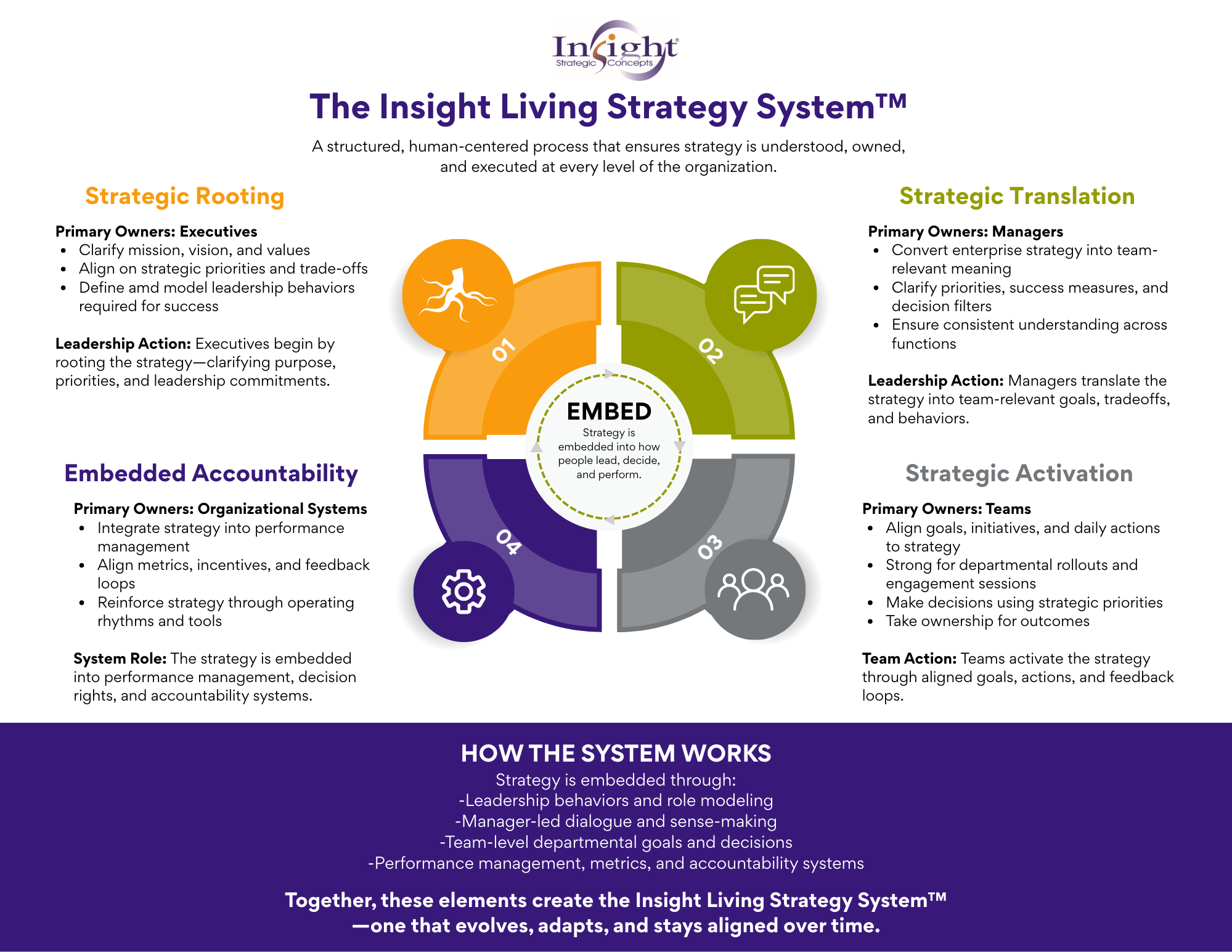
The Insight Living System™
This framework supports:
Strategic Rooting
The CEO clarifies the leadership standard.
Strategic Translation
Executives understand how behavior shapes culture.
Strategic Activation
Behavioral commitments become visible actions.
Embedded Accountability
Trust metrics become part of performance review and succession planning.
Schedule A
Preplanning Session
Schedule a time with your facilitator, Shelley Moore, to arrange the details for your prework and session date now.
- What are your objectives?
- What agenda works?
- What dates work best?
- How many team members?
- Where will the session take place?
Sessions for groups under 14 can be held at the Studio Insight in Elkhart, IN, for no extra fee.
Start Preplanning Now!
What Leaders Say...
"You get an A++ for presentation and substance... I am in the business of grazing for new thoughts and ideas. The kind of work you do is either readily in need, apparent due to performance issues, or takes time (our case) to develop relationships since the stuff you deal with goes so deep, as it should." - Larry D.
"I just wanted to take a moment to say thank you for sharing your time with our group yesterday morning. I (and I think I can speak for the others) found it very interesting and eye-opening to know that there are many others out there trying to solve the same problems that we are. I agree with you that passion is the most important part of the whole situation of a family business. Typical of most of our meetings, we all have homework to do." - Shawn H.
"Thanks again for doing such a wonderful job facilitating. Your style of communication increases my comfort level, which allows me to open up and be more expressive, natural, and willing to try new approaches. I truly appreciate what this process has done for my position here at the bank and for me personally.
The morning after, I feel a lot of different emotions. One is a very good, refreshing feeling that Doug and I now have this ability to freely engage with each other in a constructive manner that will allow for more meaningful exchanges without the worry of either of us thinking we are personally attacking the other. Another feeling is one of a touch of apprehension that, because this is out of my comfort zone, will take time for me to overcome." - Karl D.
The Insight Leadership Readiness Index™
The Insight Leadership Readiness Index™ quantifies what most succession plans ignore — behavioral trust capacity. Because leadership viability is not determined by results alone, but by the system a leader creates around them.
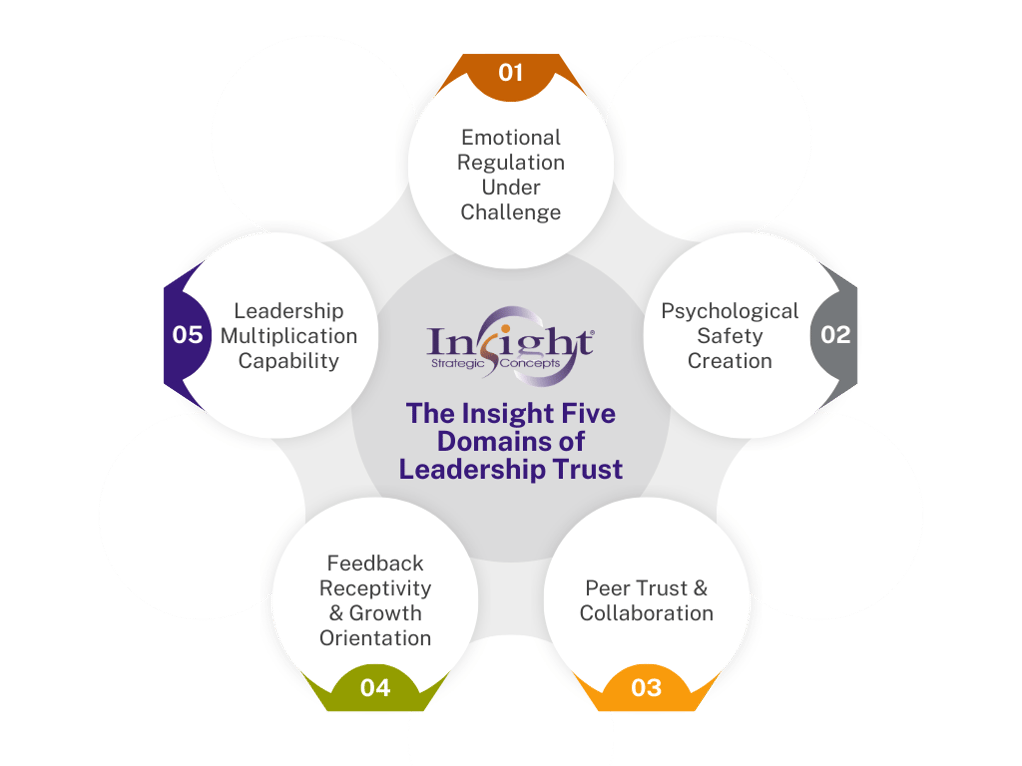
The Leadership Readiness Index™ evaluates five behavioral domains critical to succession viability.
- Emotional Regulation Under Challenge
- Psychological Safety Creation
- Peer Trust & Collaboration
- Feedback Receptivity & Growth Orientation
- Leadership Multiplication Capability
Each domain is scored on a 1–5 scale using observable behaviors.
1 = High Risk
2 = Inconsistent / Concerning
3 = Developing / Conditional
4 = Strong / Reliable
5 = Exemplary / Trust-Extending

A Behavioral Scoring Framework for Succession Readiness and Trust Viability
Purpose: To objectively assess whether an executive demonstrates the behavioral trust capacity required for succession viability.
Core Principle: Performance earns promotion. Behavior sustains leadership. Trust determines succession.
Ready to engage growth?
Click the link below to schedule a preplanning sessions for your Insight Strategic Growth Retreat today.

Return On Investment
Succession failure is not just a leadership issue.
It is a stability, culture, and enterprise risk issue.
- Reduce succession risk
- Preservation of organizational trust
- Clarity over avoidance
- Behavioral upgrade of the entire leadership team
- Financial protection
- A clear "go/no go" decision framework
The Insight Leadership Trust Reset™ protects enterprise continuity while preserving executive dignity.
Learn more about factoring your financial risk.

Who It's For
-
CEOs & Founders
-
Leadership Teams
-
Board-Chaired Organizations
-
Family Businesses
-
Nonprofits, Community Organizations, and Growth-Ready SMEs
The Investment?
Individual prework and half-day facilitated Insight Leadership Trust Reset™ sessions and The Insight Leadership Readiness Index™ process: $7,500, additional monthly successor coaching for six months $1,500 per month
-
Optional Passion Primer Leadership Development Endeavor (recommended prior to Reset, Index and dialogue): $4,000/leader >>Link to learn more
-
Optional 360 Leader Feedback Assessment: $750/leader (may change based on tool)
If the session takes place at Studio Insight, there are no space rental fees.
“The Insight Leadership Trust Reset™ is not a coaching expense.
It is enterprise risk insurance for succession.”
Shelley Moore, Founder President
Insight Strategic Concepts, Inc.